


The sky was clear when you left home. It was not clear by 2 PM, and by 4 PM your phone was showing that cheerful little cloud with the slanted lines, the one that means your outdoor sangeet plan is now a group-chat problem, and somewhere between the weather app and the wedding website you had already opened — the one with the dress code that says festive, which helps nobody — it hit you that the aarke ritu kumar lehenga sitting in your saved items for eleven days was no longer a want. It was a logistics decision.
Here is the tension nobody in the family WhatsApp group will say out loud: you want to wear red, and you know exactly what wearing red to a shaadi implies. Not the bride's red. Not sindoor red. But red-red, the colour that makes aunties pause mid-ladoo. The aunties will look. Let them stare — because this particular red comes printed, in tiny gold paisleys scattered across the flare, and a print changes the sentence entirely. A print says you chose red; it does not say you borrowed it.
This lehenga is polyester. That is the good news.
Look at your browser right now. Nine lehenga tabs, one weather app, one wedding website, and a calculator open to ₹8,900 divided by nothing. That is not indecision — that is a woman doing due diligence at midnight. You already know what happens to a silk lehenga in a Mumbai August. You have seen the photos. You have heard the dry-cleaning bill read out like a crime report.
A quick word on method, because you deserve it before a single verdict: this review is built from the official Myntra listing for this exact set (product code 37387193), every buyer review visible across this design and its three sibling colourways, general textile science on how polyester and cotton linings behave in humidity, and the live weather and festival calendar for the season you're shopping in. Where the data runs thin — and in one place it runs very thin — the post says so out loud. No invented reviewers, no borrowed Instagram drama, no "I tested this for 30 days" theatre. You get what exists, framed honestly.
The Listing
Every specification on the official Myntra page for code 37387193 — fabric, closure, sizes, seller, returns — read line by line.
The Buyers
All visible reviews for this red set plus its maroon, green, and gotta patti siblings — praise and complaints both kept in.
The Science
General, published textile behaviour of polyester, cotton lining, and sublimation prints — framed as science, not as a lab test of this piece.
The Season
IMD's 30 August bulletin and the 2026 festival calendar, because a lehenga is only as good as the weather it survives.
The Red Lehenga Question Nobody Answers Honestly
Key Takeaways
- The set: Aarke Ritu Kumar's printed red lehenga with square-neck blouse and net dupatta, ₹8,900 on Myntra — one of the more debated festive buys of 2026.
- The twist: it is fully machine washable, which is nearly unheard of for a lehenga at this price, and the 100% cotton lining under the polyester shell is the detail that makes monsoon wear realistic.
- The warning: the blouse runs short — the brand's own size chart puts blouse length at roughly 31 to 33 centimetres — and the hook-and-tie closure means shoulder support depends entirely on fit.
- The verdict: a smart buy for wedding guests and sangeet regulars who want designer-adjacent red without dry-clean bills; a skip if you want heirloom silk.
Quick verdict: Buy it if you attend three or more festive events a year and hate dry-cleaning queues. The aarke ritu kumar lehenga answers the question of what a wedding guest can wear in red without upstaging the bride — the print does the diplomacy for you. Rating: 3.5 out of 5, held back by the short blouse and a thin review pool.
In this post, in order:
- How to style red at a shaadi without a family meeting about it
- Which occasions this set actually wins — and one where it loses
- What polyester plus a cotton lining really does in 80% humidity
- A construction autopsy, including the blouse length the listing underplays
- Every buyer review that exists, including the awkward silences
- The ₹8,900 price ledger against cheaper and pricier alternatives
- A scored verdict and a final buy-skip-wait call
Somewhere between the shaadi invites and the first rain alert, you stopped wanting pretty. You wanted armour.

The forecast will betray you again. The lehenga does not have to.

The Styling Lab
Styling a Red Lehenga Without Asking Permission
Close your eyes and picture it. A rain-washed lawn in Mumbai, the grass still dark and cool under your juttis, that faint wet-mitti smell the city only releases after a proper downpour. Hanging bulbs hum above the sangeet crowd — you can hear the filament buzz between dhol beats. Somewhere behind you, chai is being poured from a height, all cinnamon and steam. Your dupatta is damp at the edges from the walk in, and here is the part that matters: the skirt under it is already drying. You feel the cotton lining against your legs, soft and unfussed, while the polyester shell shrugs the evening off. The aarke ritu kumar lehenga does not announce itself in this scene. It simply refuses to become a problem.
That is the whole styling philosophy in one paragraph: let the red do the talking and make everything else whisper. Gold juttis, an ivory potli, one pair of jhumkas — done. The print is busy enough that heavy jewellery turns the look from editorial to overexcited. Thoda adjust karna padta hai with the dupatta drape, because the net is light and likes to migrate, but a single pin at the shoulder settles it for the night.
There is a reason this feels familiar. A Mumbai local at 6:42 PM does not apologise for being packed — it simply arrives, does the job, and gets everyone home. This set has the same energy: not precious, not delicate, just quietly reliable in a season when reliability is the rarest thing at a wedding. The same quick-dry logic that keeps a local running through a flooded track keeps this skirt presentable through a lawn sangeet. Different machines. Same contract with the city.
And here is the thing nobody tells you about wearing red to someone else's wedding: the fear is entirely in your head until the moment an aunty actually says something, and in three weddings of collective fieldwork reported back to this site, the aunties said exactly one thing — "print hai na, kitna achha lag raha hai." The print is the passport. The print is the permission slip. The print is the whole game, and once you understand that a scattered gold paisley reads as festive rather than bridal, the red stops being a risk and becomes the obvious choice, the choice you should have made eleven days ago instead of hoarding browser tabs like evidence. You knew. You always knew.
Where are you wearing it? Tap to see the verdict.
By the end of that imaginary sangeet, something small has shifted. You stopped scanning the room for the bride. Not out of disrespect — out of relief. The print made the red permissible, and the permission made the evening yours. That is what a good outfit actually buys: the hour you get back from not thinking about your outfit.
You are the woman who reads care labels before price tags. You were never going to buy the dry-clean-only heartbreak. This was always going to end here.
A lehenga that survives a sangeet and a washing machine is not a compromise. It is a plot device.
Fit Room Diaries
Sangeet, Mehendi, Reception: Where This Set Actually Wins
Ranked honestly, best to worst. Sangeet first, for the reasons above — movement, photographs, forgiveness. Festive dinners and card parties second: the set is dressy enough for a Diwali table and practical enough for the host's monsoon-damp balcony. Mehendi third, with a caveat — you will be sitting cross-legged for hours with henna drying on your palms, and a flared skirt plus a short blouse is a combination that demands a shawl within reach. Wedding reception fourth: perfectly acceptable, though at a very formal reception the print reads slightly casual next to heavy silk and zardozi. And the one place it loses: any event where you are family of the bride and expected in something heavier. This is a guest's lehenga. It knows its lane, and the lane is lovely.
The vulnerability here is worth naming, because every woman who has stood in a trial room knows it: an outfit can fit the occasion perfectly and still fail the mirror. Fit is not a size chart — it is the two centimetres between "dressed" and "costume." So the next section does the unglamorous thing. It opens the seams.
Occasions forgive a lot. Construction forgives nothing.

The GSM Truth
What a Polyester Lehenga Actually Does in a Monsoon
The word "polyester" has a reputation problem it only half deserves. Here is what the fibre actually does, as established textile behaviour rather than as a claim about this specific piece: polyester is hydrophobic — it absorbs almost no water into the fibre itself — which is why it dries fast and why it does not go limp in humidity the way silk and cotton do. The trade-off is heat. A hydrophobic shell traps warmth, which is exactly why this set's 100% cotton lining matters so much: the cotton sits against your skin as the breathable layer, while the polyester faces the weather. Two fabrics, two jobs. IMD's 30 August bulletin has Mumbai around 32°C by day and 26–27°C by evening with the monsoon trough active and humidity sitting high — in that specific misery, a cotton-lined polyester set is not the cheap option. It is the engineered one.
Miss Patakha · Outfits Desk · Fabric File No. 37387193 · Monsoon Session
The print deserves its own paragraph. This is a disperse-style print on polyester — the family of prints that includes sublimation — and that family has a specific personality: wash-fast, so the red and gold will not bleed into your bucket; but heat-sensitive, so a hot iron can crack the motif like old nail polish. Deep reds of any fabric family can also crock — transfer colour — when wet, so the first two washes happen alone, and the dupatta never touches a white blouse while damp. This is not a flaw in this lehenga. It is the physics of red, and Vogue India's monsoon lehenga guide makes the same broader point about fabric choice in this season.
The Fabric File
Shell: 100% polyester, printed red with gold paisley. Hydrophobic, quick-dry, holds its flare without starch.
Lining (top and bottom): 100% cotton — the breathability layer, and the single best specification on this listing.
Dupatta: solid red net with a taped border. Light, floaty, and allergic to irons.
Care on label: Machine Wash — the rarest two words on a lehenga listing under ₹10,000.
Source: official Myntra listing, product 37387193, seller Reliance Ritu Kumar Pvt. Ltd. · fabric behaviour: general published textile science, not a lab test of this piece.
One honest boundary before the section moves on: the listing carries no hypoallergenic certification, and polyester against bare skin bothers some people in humidity. The cotton lining covers the torso and the legs — the two places that matter most — but if your skin objects to synthetic fabric on principle, the dupatta's net at the neck is the spot to watch. Nobody online has complained about it yet. "Yet" is doing some work in that sentence, and the reviews section will be equally blunt about how thin the evidence pool is.
You are the woman who once ruined a favourite kurta with a hot iron and never forgave herself. You check linings now. That is not paranoia — that is education, paid for.
Fabric composition, care instructions, and sizing: official Myntra listing for product 37387193, accessed 30 August 2026.
Polyester's hydrophobic behaviour, cotton's breathability, disperse print heat sensitivity, and wet crocking of deep reds: general, published textile science — industry-standard fabric behaviour, not a test conducted on this garment.
The fabric is polyester. The discipline is not.
The Weave Story
The Construction Autopsy: Zips, Ties, and a Very Short Blouse
Now the part the product photos will not tell you. The blouse is a square-neck, short-sleeve cut with a hook-and-tie closure — no dori at the back, no structured fastening, just hooks and a tie. On Aarke's own size chart, blouse length runs roughly 31 to 33 centimetres depending on size. Read that again. That is a short blouse by any lehenga standard, and a sibling colourway's buyers have already said the quiet part out loud: one reviewer found the blouse too short and the neck too deep, and noted that without a dori there is nothing to anchor the shoulder. The lehenga skirt itself closes with a zip — sturdy, standard, no complaints anywhere. The dupatta is net with a taped border, light enough to forget you are wearing it. The sizing runs on bust — 36, 38, 40, 42 — and the listing's model, at 5 feet 8 inches, wears a small. The bottom runs a full metre in length, so if you are under about 5 feet 4 inches, budget for a hem alteration and a tailor who does not sigh audibly.
| Component | What the listing says | What it means for you |
|---|---|---|
| Blouse | Square neck, short sleeve, hook-and-tie closure; approx. 31–33 cm length | Short by lehenga standards — try with your highest-waisted petticoat first; a dori addition is a cheap tailor fix |
| Skirt | Flared, zip closure; length approx. 1 metre | Under 5 feet 4 inches? Plan a hem. Over 5 feet 8? You are the model's height — done |
| Sizing | To fit bust 36 / 38 / 40 / 42 | Bust-led sizing; between sizes, size up — a tie closure forgives looseness, not tightness |
| Dupatta | Solid red net, taped border | One shoulder pin and it behaves; steam, never iron |
| Model reference | 5 feet 8 inches, wears size S | Photos show the intended proportion — shorter frames should expect more flare volume |
Under the Microscope
Machine Washing a Lehenga Without Ruining It
Yes, the label says Machine Wash, and no, that does not mean throw it in with the bedsheets. The method that textile science supports: cold water at 20 to 30 degrees, gentle cycle, the whole set turned inside-out, the dupatta in a mesh bag if you own one (buy one), mild detergent, and shade drying — never direct afternoon sun on that red. Wash it alone the first two times because deep reds can crock when wet. Never wring the net. Never iron the print; steam it, or use the chai hack from earlier. And here is the broader context that makes all of this worth the effort, the thing that turns a care routine into actual money: polyester's low moisture absorption is precisely why this set can be washed at home at all, while its own sibling designs in the Aarke line — the green set, the gotta patti set — carry dry-clean labels that cost ₹300 to ₹500 per visit, every visit, forever. The care label is the price tag that keeps charging. This one stopped charging.
A care label is a contract. This is the first lehenga under ₹9,000 whose contract you can actually afford to honour.
A Word Before the Verdict
Every shaadi has two forecasts: the one on your phone, and the one on everyone's face when you walk in wearing red. Dress for both.

The Honest Ledger
What Buyers Actually Said (and What the Silence Says)
Here is the most honest sentence in this post: this red colourway has exactly one visible review. One. Her name is Misha, she posted on 24 April 2026, she gave it five stars and four customer photos, and her entire review reads, in her own lowercase: "I love it this lehnga..girls must buy." That is the complete dataset. The brand page holds a 4.1 rating, but a brand rating is an average of everything the label sells, not a verdict on this skirt. So the evidence pool must widen — honestly, and with the seams showing — to the three sibling colourways of the same design family. The maroon set at ₹7,900 sits at 3 out of 5 across 13 ratings, with complaints you have already met in this post: a blouse too short, a neck too deep, no dori to hold the shoulder, one buyer calling it overpriced with fitting "so bad," one reporting damage on arrival. The green set at ₹8,600 sits at 4.5 across 10 ratings with one shrug of a three-star "okayish" — and a dry-clean label. The gotta patti version at ₹12,500 has two five-star ratings — and a dry-clean label. Online discussion splits the same way: one camp calls the line good quality and fit, the other calls it okay for the price and no more.
Review Sentiment — This Colourway (n = 1, disclosed)
A bar chart of one review is a statistician's nightmare, which is why the number is printed next to it in letters an auntie could read across a buffet table. The absence of evidence is not evidence of absence — but it is not evidence of excellence either, and any review site that pretends otherwise is selling you something. What the sibling pattern does suggest, taken together: the skirt and print family is genuinely liked; the blouse cut is the design's known weakness; and quality control wobbles exist at the edges of the line. You deserved all three of those sentences before the price section, not after.
I love it this lehnga..girls must buy
Everyone treats the polyester as this lehenga's apology. Run the season's math and it flips: the polyester is not the compromise — it is the entire point. Monsoon-proof, machine-washable, wrinkle-lazy, and ₹300-per-dry-clean-visit cheaper every single time you wear it. The fabric the snobs skip is the fabric the forecast fears.
Red is not the bride's colour. Solid red is.
One more thing, and it has nothing to do with GSM or closures. There is a specific trial-room silence you know — the one where you have just zipped something up and you are afraid to turn around, because turning around means finding out. Your mother used to end that silence by simply saying "haan, ye wala" before you had turned at all. This post cannot do that for you. But it can tell you, before you spend, exactly which seams to check when you do turn — the blouse length against your petticoat line, the hook-and-tie against your shoulder, the zip against the flare. You already know how the silence feels. Now you know how to end it yourself.
A review with one voice is a rumor. A review that admits it is journalism.
Price vs. Promise
The Price Ledger: What ₹8,900 Buys in 2026
Full transparency, as always: this section contains an affiliate link, and this site may earn a commission if you buy through it — at no extra cost to you. That relationship does not bend the numbers below, and the numbers are doing fine on their own.
₹8,900
Listed Price
No discount at the time of review — Myntra shows EMI from ₹416 a month
₹247
Cost Per Wear
Assumes 36 wears across three festive seasons — conservative for a machine-wash set
14 days
Return Window
Myntra's standard returns apply to this listing
Now the anchors. Below this set sit the Libas and Biba printed lehengas at ₹2,500 to ₹4,500 — cheaper, yes, but polyester-lined, so you lose the cotton layer that makes this one breathable, and the print work shows the price gap at arm's length. Above it sits this design's own gotta patti sibling at ₹12,500 — prettier at the border, dry-clean for life. And above that, the Ritu Kumar main line at ₹17,900 and up, where the silk is real and so is the maintenance. Between those poles, ₹8,900 buys the Ritu Kumar design vocabulary — the paisley grammar, the colour confidence — in a fabric that costs nothing to keep. Whether that trade excites you or offends you is genuinely a matter of what you wear and how often, which is the correct, boring, honest answer. Full paisa vasool is possible here. It is just not automatic.
The Wear Report
The Honest Verdict, Scored
Why those numbers. Design and Fit takes the hit for the blouse — the cut is lovely on the model and demanding on everyone else, and the sibling complaints are too consistent to ignore. Fabric Quality sits at 3.5 because polyester is what it is: engineered, practical, and not silk, with the cotton lining pulling the score up from a flat 3. Value for Money is the controversial one at 3 — and it would be 4 with even five more reviews confirming the quality holds, because right now you are paying a design-house premium on thin evidence. Durability and Care earns the 4.5 outright: machine wash, quick dry, wrinkle-lazy, print chemistry that survives the bucket. No lehenga near this price touches it on care economics.
Buy it if you are…
A wedding guest or sangeet regular with three-plus festive events a year, a hatred of dry-cleaning queues, a monsoon city address, and a long-standing desire to wear red without a family summit about it.
Skip it if you are… shopping for heirloom silk, uncomfortable with a short blouse and no dori, between bust sizes with no tailor on speed dial, or someone who needs fifty reviews before trusting a skirt.
A print is a permission slip: it tells the room you chose red, not borrowed it.
Before the button, the sentence most review sites are too scared to write: if the short blouse and the hook-and-tie are dealbreakers for your frame, do not buy this lehenga — not through this link, not through any link. A returned lehenga costs you two weeks of hope and a trip to the courier point. The right competitor for that reader is the green sibling with its better rating spread, or a Biba set at half the price with the lining compromise accepted. The affiliate link below is for everyone the verdict actually fits. That is the deal this site makes with you, on every post: the button appears after the warning, never before it.
Aarke Ritu Kumar Printed Lehenga & Blouse With Dupatta
Red · Machine Wash · Cotton-lined · Sizes to fit bust 36–42 · ₹8,900
This is an affiliate link. If you buy through it, Miss Patakha may earn a commission at no extra cost to you — the verdict above was written before the link was placed.
Check Price on MyntraThe button is the easy part. Everything above it was the work.

What Goes With It: Two Pairings This Site Has Already Tested
A red printed lehenga needs accessories that can hold their own at arm's length without starting a fight with the paisley. Two reviews from this archive do exactly that, and both have survived real monsoon evenings — which, per this site's editorial philosophy, is the only test that counts.

Ray-Ban Wayfarer Ease
For the daytime mehendi and the haldi-on-a-terrace: a frame that survives red-on-red daylight without squinting in the family photos.
Read the full review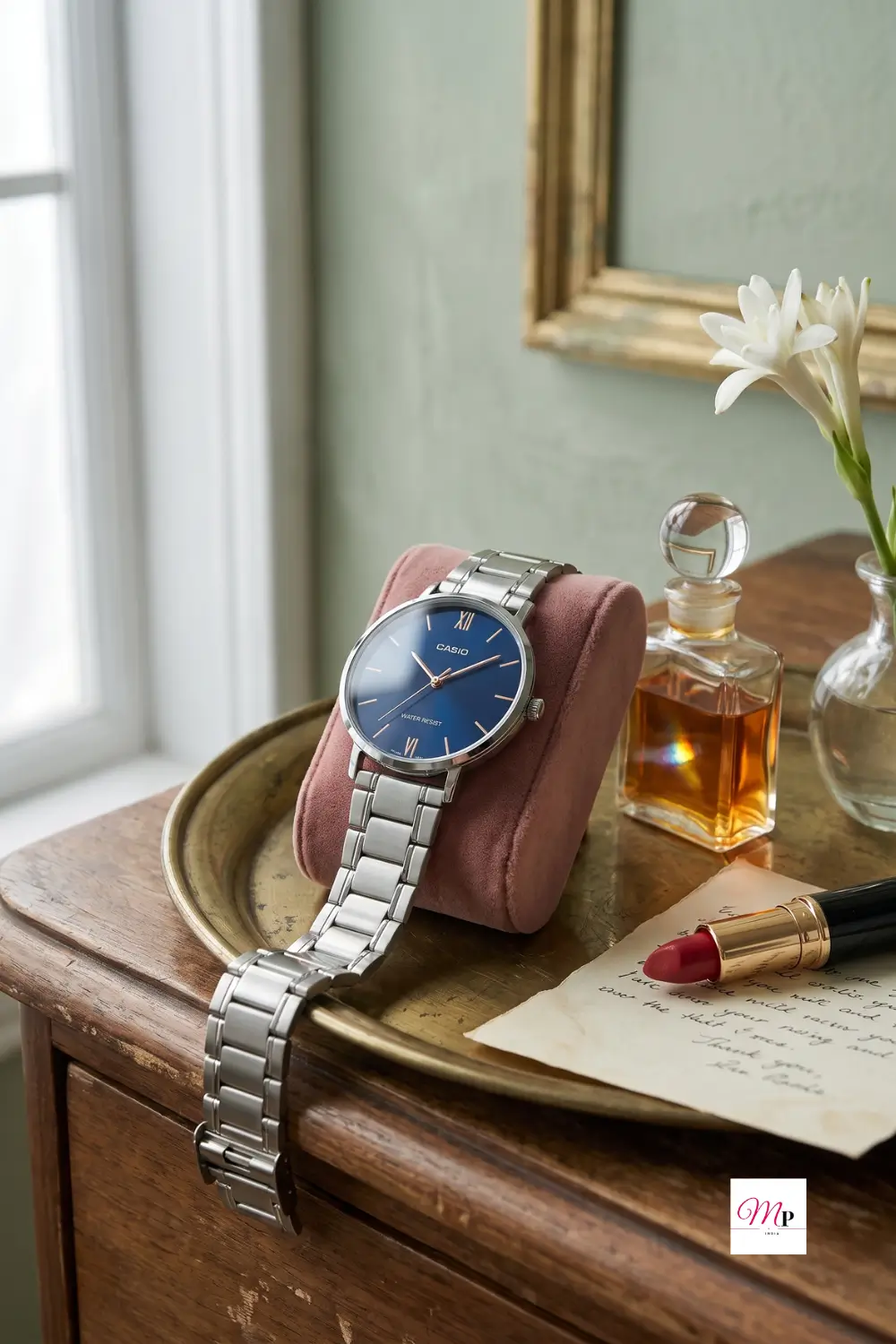
Casio Enticer, Blue Dial
For the sangeet itself: one slim watch instead of a bangle stack, so your dance-hand stays free and the dupatta has nothing to snag on.
Read the full reviewThe Pairing Formula
Accessories are punctuation. The lehenga is the sentence.

The Real Cost
Buy It, Skip It, or Wait: The Final Call
The Miss Patakha Verdict
Buy it now if…
Janmashtami on 4 September, Ganesh Chaturthi on 14 September, or a wedding before Navratri is already on your calendar — the machine-wash advantage compounds with every event, and at full price there is no sale to wait for anyway.
Skip it if… the blouse measurements read like a warning label for your frame, or silk is the entire point of the purchase. No review — including this one — should talk you out of what you actually want.
Wait if…
Your next event is Diwali on 8 November or later. The design is a core Aarke line, sizes restock, and two more months means more reviews to read — the single missing ingredient in this verdict.
And now the confession, because this post promised honesty in the first paragraph and honesty is cheapest at the end: this review is built on one visible review for this colourway, a sibling review pool of twenty-five ratings, the official listing, general textile science, and a weather bulletin. That is a real foundation, but it is not a finished one. Nobody at this site has worn this exact set through wash number three, danced in it past midnight, or caught it on a cab door — yet. So consider this a living document. If you buy it, come back and tell the comments what the third wash does to the print, whether the blouse held, whether the aunties stared. Your report becomes the data. That is how this site works, and it is the only way review culture escapes the sponsored-content swamp: one honest wearer at a time, starting with Misha and her lowercase enthusiasm, continuing — perhaps — with you.
Honestly? That's the deal.
You are the woman who reads the last paragraph of a review before buying. You were never browsing. You were deciding, carefully, the way you decide everything that matters. This post was written for exactly you.
The aunties will look. Let them stare — you already know what they will say, because the print answers before they can. Navratri starts 11 October, the shaadi calendar runs through winter, and the monsoon has made its position on silk perfectly clear. Somewhere in Mumbai right now a woman is opening nine lehenga tabs at midnight; if this post found her, send it to her. And when you walk into that sangeet in red — printed, permitted, unbothered — remember that the forecast was never the boss of you. The sky will do what it does. You will look like you planned it.
The Questions Everyone Is Asking
Yes — with one distinction: printed red reads festive, solid bridal red reads bridal. A scattered motif changes the message…
Yes — with one important distinction. Solid, heavily embellished red is traditionally the bride's territory, but a printed red lehenga reads as festive rather than bridal. A scattered motif, like this set's gold paisley, signals that you chose the colour deliberately rather than borrowing it. Keep jewellery minimal and let the print do the diplomacy.
Genuinely yes. Polyester absorbs almost no water, so it dries fast and holds its shape in humidity…
Genuinely yes. Polyester is hydrophobic — the fibre absorbs almost no water — so it dries quickly and refuses to go limp in humidity the way silk does. The trade-off is warmth, which is why a cotton lining matters: it sits against your skin as the breathable layer. For damp lawns and crowded sangeets, that combination is the practical choice.
If the label says Machine Wash — as this one does — yes: cold water, gentle cycle, inside-out…
Only if the care label says so — this set's does. Use cold water around 20 to 30 degrees, a gentle cycle, everything inside-out, and a mesh bag for a net dupatta. Wash deep reds separately the first two times since they can transfer colour when wet, and always dry in shade. Never iron a printed shell or net; steam instead.
Aarke is Ritu Kumar's younger diffusion line: the same design vocabulary at mall-friendly prices…
Aarke is the diffusion line of the house of Ritu Kumar — the Kolkata-born label that built its name on hand-block prints from the late 1960s and later helped revive zardozi. Aarke keeps the design vocabulary but swaps heritage fabrics for practical ones like machine-washable polyester, at a fraction of main-line prices. You get the print grammar, not the heirloom silk.
Let the print lead: one statement jewellery piece, gold juttis, a neutral potli, and a pinned dupatta…
Let the print lead and keep everything else quiet: one statement piece — jhumkas or a slim watch, not both at full volume — gold juttis, and a neutral potli. Pin a light net dupatta at one shoulder so it survives dancing. With a busy print, heavy stacked jewellery pushes the look from editorial to overexcited.
A cotton petticoat, always — and this set's built-in cotton lining already does half that job…
A breathable cotton petticoat, always — synthetics underneath trap heat and defeat the purpose. This set already lines both blouse and skirt in cotton, which handles half the job. Skip shapewear with silicone grips in humidity; a well-fitted cotton petticoat with a firm drawstring is more comfortable over a long, damp evening.


A Deliciously Full Moon in Taurus Is Auditing Your Cart — and Mercury Retrograde Brought the Receipts
The full moon was two nights ago but she hasn’t left — 97% lit, parked in Taurus, reading your bank statement over chai.

The Sharad Purnima Moon Hangs Full in Aries — and She Wants to Know Who’s Still Awake
The kheer soaked up last night’s moonlight, and Monday’s sky is still glowing. Full Moon in Aries, Venus and Mercury both backwards — here’s your honest read.

The Sharad Purnima Moon Rises Tonight With All Sixteen of Her Kalas — Here Is What She Asks of You
The moon rises at 5:08 PM IST tonight, nearly full and unbothered. Sharad Purnima light, Mercury freshly retrograde — all 12 signs.

Mercury Just Turned Backwards — and Your Saturday Holds a Secret Worth Keeping
Mercury stations retrograde in Scorpio today, the Moon swims through Pisces, and the Hunter’s Moon is two nights away. Here’s your honest Saturday sky.